
Build the Skills to Start Your Career in Bioinformatics & Genomics.
Learn how diagnostic genomics labs process Next-Generation Sequencing (NGS) data, call genetic variants with GATK, and curate clinical molecular reports to ACMG/AMP guidelines. Develop practical skills through structured training, case-based exercises and reproducible pipeline workflows.
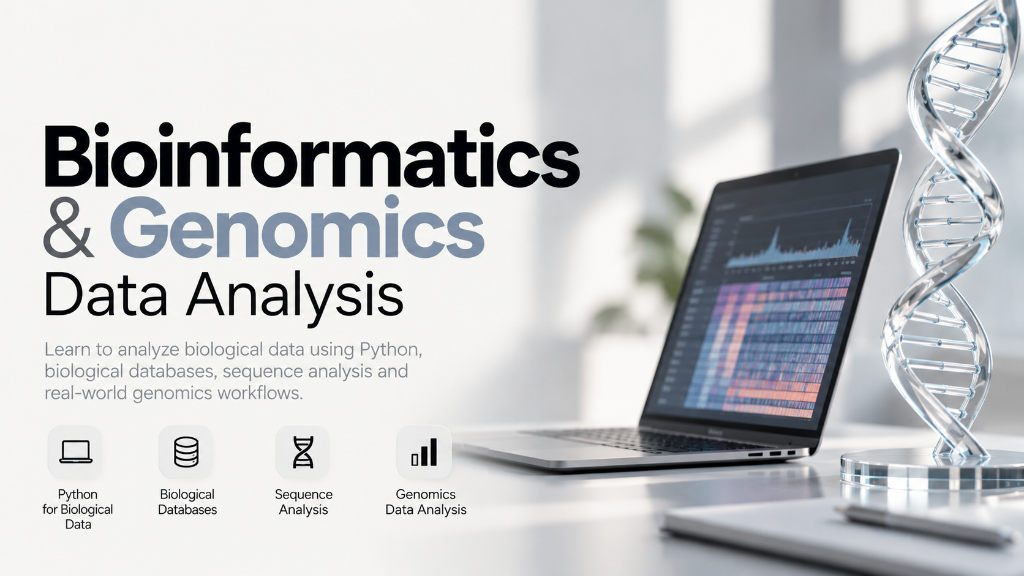
What is Bioinformatics & Genomics?
Bioinformatics bridges biological science with computational data analysis. Clinical genomics laboratories sequence DNA and RNA to uncover mutations, diagnose rare genetic disorders, profile tumor biologies, and tailor personalized therapies for patients.
Secondary NGS Processing
Inspect FASTQ quality, perform reference mapping with BWA-MEM, and generate coordinate-sorted BAM files.
GATK Variant Calling
Execute GATK HaplotypeCaller with BQSR calibration to identify SNVs, Indels, and structural mutations.
Annotation & Population Filters
Cross-reference candidate variants against Ensembl VEP, ClinVar, gnomAD, and dbSNP database catalogues.
ACMG/AMP Clinical Classification
Score variant pathogenicity using the 2015 5-tier framework (PVS1, PM2, PP3) for diagnostic sign-off.
Transcriptomics & RNA-Seq
Quantify gene expression with STAR and DESeq2 to identify differentially expressed disease biomarkers.
Production Nextflow Pipelines
Orchestrate reproducible pipelines with Nextflow DSL2 and Docker containerization for audit readiness.
Where Do Clinical Genomics Graduates Work?
Bioinformatics and genomics skills open direct pathways into high-demand precision medicine diagnostic hubs and global healthcare GCCs across India.
Clinical Genomics Labs
Germline whole-exome sequencing, carrier screening, and rare Mendelian disease discovery.
Somatic Oncology Profiling
Solid tumor gene panels, liquid biopsies, and actionable targeted therapy matching (Tier I/II).
Pharmacogenomics Units
Drug-gene interaction analysis (CPIC guidelines) to optimize dosing and prevent ADRs.
Global Bio-IT & GCCs
Cloud genomic workflows, Nextflow pipeline engineering, and clinical trial molecular data curation.
The 5-Stage Clinical NGS Analysis Workflow
Every module in the 12-week curriculum is anchored directly in the end-to-end clinical genomic workflow used by accredited diagnostic sequencing facilities.
FASTQ Intake & QC
Assess base quality scores (Q30 > 90%), adapter content, and sequence duplication before alignment.
Read Alignment
Align reads against GRCh38 human reference; sort, index, and mark PCR duplicates with Picard tools.
Variant Discovery
Apply Base Quality Score Recalibration (BQSR) and discover germline SNVs, Indels, and copy number shifts.
Tertiary Annotation
Filter candidate mutations by minor allele frequency (< 0.01) and query ClinVar and OMIM records.
ACMG Sign-Off
Visually verify alignments in IGV, assign 5-tier ACMG scores, and draft the final diagnostic report.
Reverse-Engineered From 150+ Verified JDs
Recruiters screening freshers for Bioinformatics Analyst and Clinical Genomics positions look for demonstrable proof of tool execution, not generic theory.
Bash automation, file pipes, awk/sed parsing of biological text streams.
Biopython SeqIO parsing, pandas tabular transformations, REST API queries.
End-to-end secondary pipeline execution: FASTQ to calibrated VCF files.
5-tier clinical interpretation using ClinVar, gnomAD, and in silico predictors.
Inspection of split reads, mapping quality, homopolymers, and strand biases.
Reproducible pipeline orchestration, nf-core standards, and Docker containers.
The 12-Week Role Readiness Pathway
Organized into 6 sequential two-week modules, each producing an audit-ready technical deliverable for your interview portfolio.
Linux Foundations, Shell Automation & Python for Biology
Biological Databases, Sequence Alignment & BLAST Homology
NGS Secondary Analysis Pipeline (FASTQ → BAM → VCF)
Variant Annotation, Filtering & IGV Read-Level Visualization
Clinical Variant Interpretation (ACMG/AMP 5-Tier Guidelines)
Transcriptomics (RNA-Seq), Nextflow Workflows & Capstone Viva
Audit-Ready Clinical Deliverables
Every graduate leaves with an authenticated portfolio containing real clinical work samples, demonstrating to employers that you can evaluate genomic data accurately.
ARZ-WES-2026-018 · MSH2 (NM_000251.3): c.942+3A>T
Mentored by Experienced Genomics Scientists
Learn directly from senior bioinformaticians and molecular geneticists who have processed thousands of clinical exomes, oncology panels, and rare disease cases at accredited genomics diagnostic centers.
Clinical Genomics Advisory Faculty
How Arzon Prepares You for Real Recruiter Interviews
We go beyond video lessons: your preparation culminates in a GitHub pipeline portfolio and rigorous technical viva drills.
GitHub Pipeline Portfolio
Recruiters test your command-line fluency. You will publish reproducible Nextflow workflows and clean Python code with documented READMEs.
ACMG Molecular Case Dossier
Walk into technical interviews with a binder of validated clinical case interpretations demonstrating your exact scoring methodology.
Mock Technical Viva Drills
Practice answering complex recruiter screening questions: explaining Ti/Tv ratios, strand biases in IGV, and VUS reclassification rationales.
Frequently Asked Questions
Clear answers to the most common questions from students and graduates.
Arzon Global does not guarantee job placements. We provide practical role-based education, portfolio deliverables, and technical interview preparation. All curriculum modules adhere strictly to ACMG/AMP 2015 Standards and Guidelines for the Interpretation of Sequence Variants, CAP/CLIA NGS validation standards, and GA4GH genomic exchange frameworks.